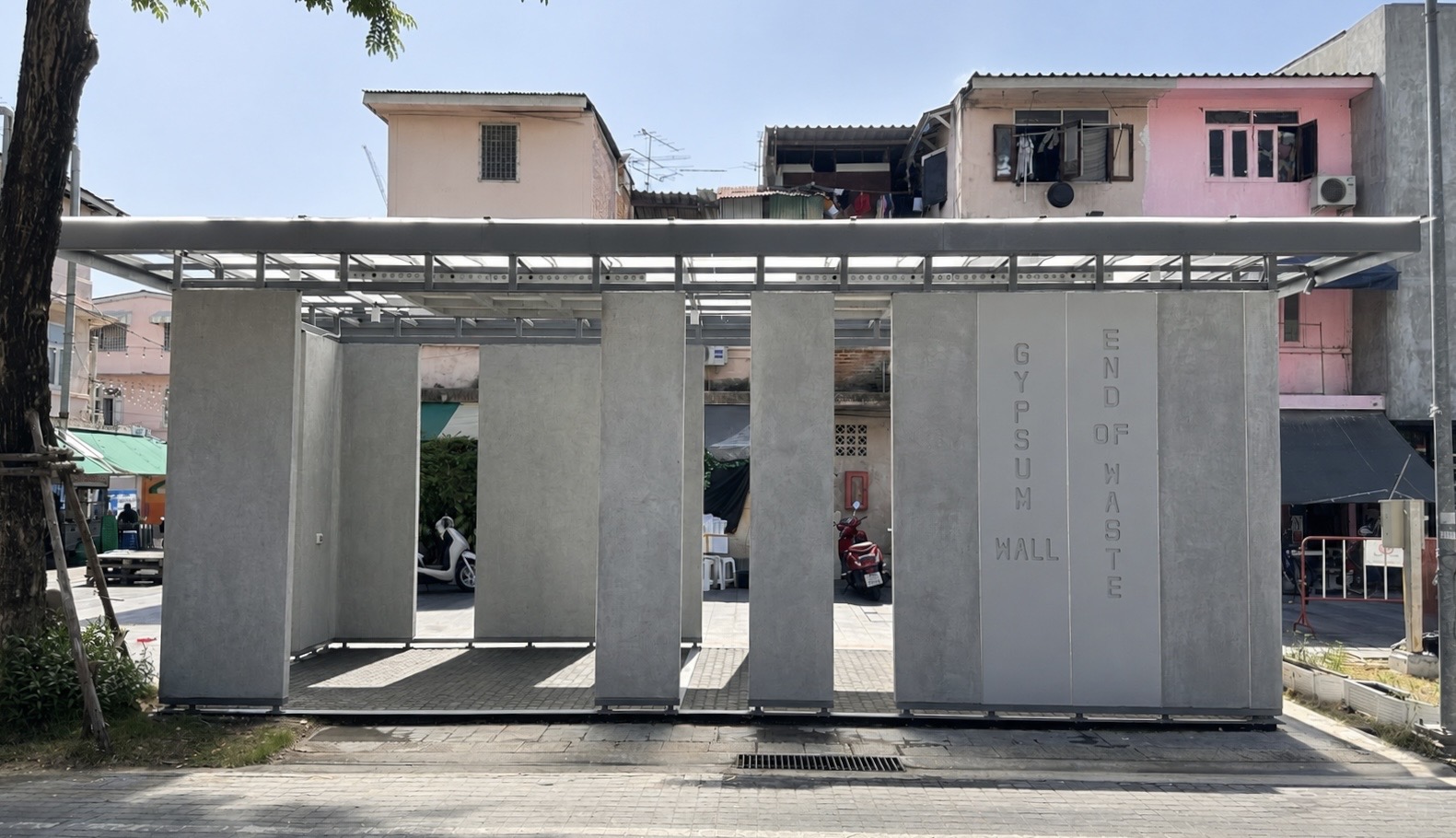
End-of-Waste: Turning Waste into Resources for the Built Environment
Project: End-of-Waste
Location: Chulalongkorn University Centenary Park, Thailand
In collaboration with: ศสอ. จุฬาลงกรณ์มหาวิทยาลัย × BMS – Build Matter Solution × Aromatic Farm
“Waste is only waste when we stop imagining what’s possible.” ♻️
The End-of-Waste Project is a collaborative initiative that explores how residual materials from construction and agriculture can be recovered, re-engineered, and transformed into new resources for the built environment.
Through the collaboration between ศสอ. จุฬาลงกรณ์มหาวิทยาลัย, BMS – Build Matter Solution, and Aromatic Farm, the project brings together knowledge, material innovation, and bio-based resources to demonstrate how Circular Economy principles can move from concept into real-world application.
SALA THAMSONG — A Living Material Showcase
At the center of the project is SALA THAMSONG, a pavilion that brings different waste streams together within one architectural application.
The project explores materials including recovered gypsum waste from building demolition, together with biochar and coconut fiber derived from agricultural residues at Aromatic Farm.
BMS works on the research, development, and material integration process, exploring how these residual resources can be transformed and incorporated into construction materials and applications.
The material journey follows a simple idea:
Waste → Resource → Material → Built Environment
Connecting Agricultural and Construction Waste
Rather than looking at waste streams separately, End-of-Waste explores how resources from different industries can become part of a connected circular material system.
Recovered gypsum represents an opportunity to extend the lifecycle of existing construction materials, while coconut fiber and biochar from Aromatic Farm demonstrate how agricultural residues can be transformed into valuable bio-based resources.
Through material research and engineering, these resources are given new possibilities beyond their original lifecycle.
From Circular Thinking to Real-World Application
End-of-Waste demonstrates that Circular Economy is not only about reducing waste. It is about rethinking how we value, design, and use materials from the beginning to the end of their lifecycle—and how we bring them back into use again.
By combining academic and project collaboration, material innovation, and agricultural resources, ศสอ. จุฬาลงกรณ์มหาวิทยาลัย × BMS × Aromatic Farm demonstrate a practical pathway toward a more circular built environment.
Recover. Re-engineer. Reuse.
Because the future of construction isn't built from waste—
it's built from the value we choose to recover.