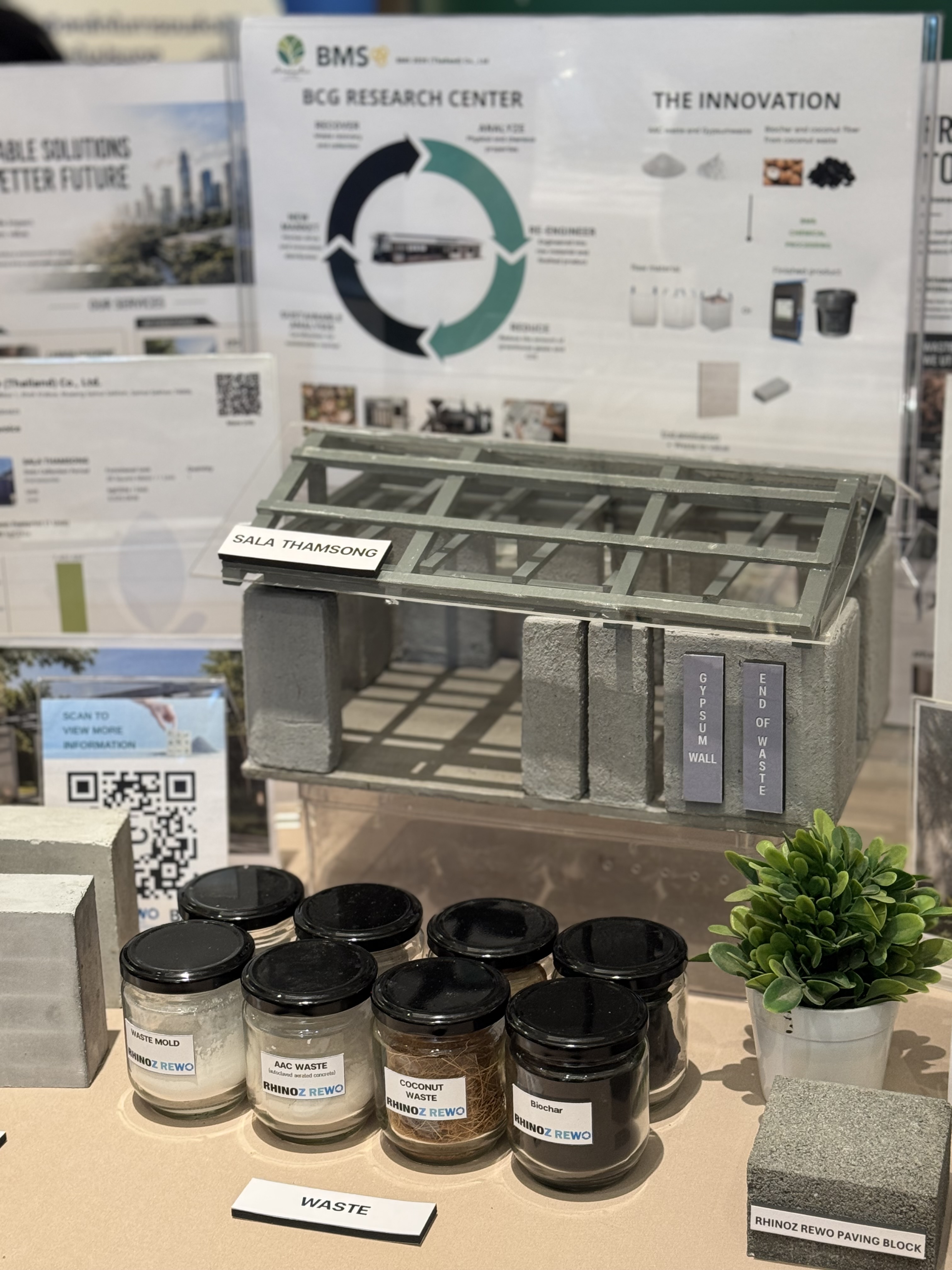
BMS × RHINOZ REWO Showcase SALA THAMSONG model at the End-of-Waste Event
BMS and RHINOZ REWO are proud to be part of the End-of-Waste Project, working in collaboration with ศสอ. and Chulalongkorn University on the development of SALA THAMSONG—a project that brings the concept of the Circular Economy into real-world architectural and construction material applications.
As part of this collaboration, BMS explores how agricultural and industrial residual materials can be transformed into new resources for the built environment. One of the key materials used in the project is Biochar derived from agricultural residues from Aromatic Farm, connecting waste from the agricultural sector with material innovation and construction applications.
On 13 August 2026, the BMS and RHINOZ REWO teams joined the End-of-Waste event and showcased a scale model of SALA THAMSONG, presenting the concept behind the pavilion, its material development, and how different waste streams can be brought together as part of a circular material system.
The showcase represents the transformation journey:
Waste → Resource → Material Development → Built Environment
SALA THAMSONG incorporates various residual materials, including Biochar, Coconut Fiber, AAC Waste, and Gypsum Waste. Rather than treating these materials simply as waste to be disposed of, the project explores their potential as alternative resources that can be studied, developed, and reintegrated into construction materials.
One example is the development of the pavilion’s surface finishes by RHINOZ REWO, incorporating Biochar and Coconut Fiber into the material. Agricultural residues from Aromatic Farm are transformed into Biochar and further explored as part of the material development process, demonstrating how waste from one industry can become a resource for another.
Another application is the Carbon Storage Paving Block, which integrates Biochar together with recovered materials into paving applications. Through this approach, the project explores not only how waste can be diverted and reused, but also how Biochar can be incorporated into construction materials as a form of long-term carbon storage.
These developments represent an approach to material design that looks beyond function and aesthetics. It considers the origin of materials, waste reduction, resource circulation, and the potential environmental value that materials can create throughout their lifecycle.
The scale model showcased at the event was therefore more than a representation of SALA THAMSONG. It served as a tangible example of collaboration across different sectors—from agriculture and material innovation to construction and academia—and communicated a broader idea:
“Waste can become a Resource.”
Residual materials from one process can become valuable inputs for another when supported by research, design, collaboration, and material development.
At BMS, we believe that the Circular Economy should go beyond being a concept. It should be translated into tangible materials, products, and built applications that demonstrate how resources can remain in use and continue to create value.
Through the collaboration between BMS, RHINOZ REWO, ศสอ., Chulalongkorn University, and Aromatic Farm, SALA THAMSONG represents another step toward connecting Material Innovation, Circular Economy, Agriculture, and the Built Environment.
It reflects our ongoing commitment to exploring new possibilities for residual materials and transforming them into resources that can create new value for the construction industry and contribute to a more circular future.
Transforming Waste into Resources.
Transforming Resources into Better Materials.